Friday, February 16, 2018

Lesson and Activity: Pointillism

Pointillism

Pointillism is a style of painting that was used primarily between 1880-1900. It involves painting with a bunch of tiny little points of paint. A few things motivated pointillism. First, most paintings of this time were of landscapes and people enjoying life outside. This style was called “Impressionism” and developed as a result of cameras. Before this time, painters would focus on a person seated or standing inside of a room, the background would not be important. With Impressionist artwork, the background was just as important as the people captured in the painting. In fact, in many cases, the background was more important than the people in the painting. In addition, because paints were more portable, artists would work outdoors in the air, and would think about lighting and how to create more realistic artwork. This was an exciting new time, as the concepts of photography merged with paint.

Pointillism arose from this genre of artwork. It is actually scientific. The color wheel (aka ROYGBIV) was developed around this time. The concept was to create an OPTICAL ILLUSION – essentially tricking your eyes to see different colors by putting small dots of unmixed paint near each other. For example, instead of mixing purple paint, a pointillist artist would put dots red and blue close together. Very close up, you would be able to see the dots of red and blue, however standing back, you would only see purple.

This concept of dots making an image is the same as the pixel that is used in our TV’s and computer screens. The more pixels there are per inch, or the more closely packed the pixels are, the clearer the image will be. Digital cameras also use pixels to pick up light. The more pixels there are, the clearer the pictures the camera can take.

Let’s look at a very famous pointillism painting by French painter Georges Seurat, called Sunday Afternoon on the Island of Le Grande Jatte. It took him 2 years to paint this huge painting with little dots of paint. The painting is 10 feet wide by 6 feet tall. If you look closely at the picture, you will be able to find the monkey.


-T.E.A. 2018, TorahHomeschoolFamily.blogspot.com


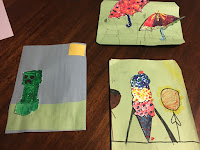
Activity: Now you can try pointillism art!
Materials:

-Paint – Dollar Tree Poster Paint works
-QTips (Again, you can find these easily at Dollar Tree)
-Card stock
-Construction Paper
-Scissors
-Glue

  1. Find coloring pages that interest your children and print on Cardstock paper. I have four examples here. **Make sure the coloring figures aren’t too large, because it will take longer to color the figure in with dots.
  2. Put small amounts of each color paint in a paint well or on a paper plate.
  3. Give the children qtips and tell them to paint the figures with dots.
    •  Older children can use the Optical Illusion concept and try putting primary color dots near each other to make blended colors. For example, ROYGBIV – Put red and yellow dots near each other to make Orange.
    • Younger children can mix their colors on their plates using ROYBIV, or be given already mixed colors.
    •  Even younger children (2+) can just use the qtips to smear the paint all over their figures, and forget about making points. It’s FUN!
  4.  Allow the figures to dry.
  5.  Cut out the figures and use the construction paper to make a background scene. Then glue the figure to the scene.


Pictures we used:

Minecraft Creeper: http://www.supercoloring.com/coloring-pages/creeper?version=print

Umbrella: http://coloringhub.com/wp-content/uploads/2013/11/Umbrella-coloring-pages-11.jpg

Butterfly: http://www.raisingourkids.com/coloring-pages/animal/butterfly/005-butterfly-to-print-color.html

Car: http://sweetclipart.com/multisite/sweetclipart/files/toy_car_cute_coloring_page.png

Ice Cream Cone: http://www.getcoloringpages.com/coloring/21605


Thursday, February 1, 2018

Help! My Child Doesn’t Want to be Withdrawn from School!

Change can be scary. The decision to take your children out of school is a scary one and is not taken lightly. You don’t know what to expect! You are concerned about the process. You are concerned about how it will affect your children’s lives both educationally and socially. You are concerned about the results! And, often children feel a sense of anxiety too... especially if they are old enough to  actually be aware of the coming changes.

Some children will be against being withdrawn from brick and mortar school and being homeschooled. For them, school education is all they know. The may not want to leave their friends and teachers (similar to a move to another school district), they may have fears like not being able to go to college, or they may be afraid of becoming “weird kids” - those who differ from their peers. Especially for teens, there is something to be said about the freedom that comes with school.  They may be so used to their lifestyles that the thought of being home for more hours of the day, around their parents and siblings, may sound just plan scary!

Then, there is the child who has been withdrawn, but asks to go back to school. Again, the social interactions and freedoms may be missed, but the child may also miss the structure and organization of brick and mortar schooling. They may miss a certain class, or a teacher’s style,.. they may miss gym class or art class.

It is important to recognize that NONE of these things they miss or are afraid of missing is wrong in and of themselves. They are just not in alignment with the decision to homeschool.

Everyone’s circumstances are different. And, homeschool isn’t for every parent and every child. Some children do better in a more institutional setting. Some parents find that they aren’t able to teach their child, or they aren’t able to take the burden of their children’s education because of work or other obligations. I believe that the opinions of our children are important, and that we as parents should always listen to our children and work to understand where they are coming from. This is for the sake of the mental and emotional well being of our children...

However, at the same time, parents must realize that they are raising their children, and are not their children’s friends. Children are not yet experts in life, and they need steering to bring them up in this world filled with thorns and darkness. Similar to the decision to move to another school district, the children may feel a concern about the change, however that will not be THE determining factor on whether or not the family will move. In the same way, a child’s opposition to being withdrawn from school should not be THE determining factor in whether or not to withdraw them and homeschool.

If you decide to homeschool and your child is not on board with the decision or lifestyle change, examine WHY you want to homeschool. If you have an ethical or moral reason that can’t be changed, then I suggest you  gently explain to him or her WHY you are making this change in their life. Explain why this is something that you are compelled to do, and that if they follow your lead in this, then they will be blessed.

Some parent-child relationships are more cooperative - it’s a democracy. This may be the case for the high school senior who is about to enter into the real world. I think wisdom needs to be used for these type of relationships. If you as the parent truly believe the child needs to be withdrawn from school, then you need to make the decision that aligns with that conviction. It may be beneficial for them to meet homeschooled children, go to an event with homeschool children, or making the transition to homeschool a fun and creative one.

Homeschooling is like every decision we make for our children. We do things that we think will help them become the people we are raising them to be. Change in life is inevitable. For some children, the change to homeschooling will be the first major change in their lives. It may be a valuable lesson that they remember for the rest of their lives.

T.E.A. 2018

But I don’t have a teaching degree...


When my family first decided to take our children out of school, our first thought wasn’t the common “what about socialization?,” our first thought was more so along the lines of knowing HOW will we teach our kids.

When I was in college, I had many frustrating classes taught by professors and post docs who were BRILLIANT in their fields of research, but were absolutely LOUSY at conveying basic information to other people. I remember asking on of my physics professor to explain something to me, and he stuttered his way through an explanation until he was red in the face. Then he asked if I understood, and I said yes just for the sake of giving him a break. He wasn’t trying to not be helpful to me, but he couldn’t formulate the information that he could understand perfectly in a way to educate me.

I am sure that there is a benefit to learning the theory behind education. There is a benefit to learning how different learners think. There is a benefit to spending time and energy not only knowing your field of study, but also how to convey that information to another individual effectively.

So, when people come to me and say they would homeschool, however they don’t have a teaching degree, I am very understanding of this concern.  If your children can’t learn from you, then this is a very serious problem. It may prevent you from being able to homeschool your children on your own. But there are ways around it.

I spoke with two other mothers today about teaching our children to read. One thing we found in common was that our children reached a maturity to read on their own around the age 8. Another thing we found in common was that it took some trial and error, different curriculum to get them to the point that they could read.

Here are some suggestions for parents who are thinking about homeschooling, and have this concern:

1. You must be resourceful. Some parents are able to afford private tutors to teach subjects that they don’t understand. Or they get other family members to do it. However, in the age of technology, there are online classes for nearly every subject for free or paid, and also cyber schools. In addition, there are paid subscription programs and local opportunities at science centers and even universities that help teach homeschooled students a variety of topics.

2. Learn how your children think. Spend time to analyze how they learn, and evaluate them to figure out if they are learning and retaining the material that you are teaching them. If they aren’t learning, change your approach or learning materials.

3. Find curriculum that meets your needs. Don’t dive into a curriculum and keep it just because you bought it. If it doesn’t work, change it. Learn how to go with the flow.

A lot of my teaching friends find that being a teacher gets in the way of their ability to flow with educating their children. School can be vastly different from homeschooling. Sometimes a fresh slate, so to speak, is good when educating your children at home.

Our family views education as simply raising our children. We don’t need a degree to know what’s best for our children. The daily educating of our children includes training them in righteousness/Torah, teaching them how to be people of a good character, and teaching them how to read, write, and excel in every area of life.

-T.E.A. 2018

Help! How do I Balance Life and Homeschool?

Honestly, I don’t know how to balance life in general. LOL! So, maybe I’m not the best person to write on this subject. At this moment, I have a mountain of clean laundry to fold, and dinner to warm up... and I’m writing this blog instead of tending to those tasks, but... ahem...


Balance!


This is something that we all need to find in life. How do we manage all the roles that we have... mothers, wives, sisters, friends, employees, students, etc. When I was a working mom, I had to balance raising children with a 10 hour chunk of my weekdays missing. I eventually found a balance - start work at 7, get off at 3:15... pick kids up from daycare or off the school bus, cook dinner, homework time, clean up, bath time, etc. Being a stay at home mom with two older kids and two young babies has led me to find another system that works for my day. It’s a trial and error process, and it evolves over time, but eventually, if we keep striving for it, we find balance.

New homeschool parents typically run their “school days” or times in a fashion like the institutional education they were brought up in. 5-8 hours of school, start early in the morning, etc. It takes a lot of effort to do things this way if you have younger children to take care of. I encourage parents to customize their education styles, hours, and days to what works best for their households.

For example, we do work on Sundays so that my husband can watch our babies while I work with the older children on tasks that I need to focus on. There have been times also when we work in the evenings when my husband is home from work because I need him to watch the younger children. We also are very flexible in the number of hours we do each day. Some days, we work 2-3 hours, while other days we work 5 hours, and some days we just focus on one subject for however long it takes. If my child seems to not be able to concentrate very well one day, I may even let him or her go and do some constructive activity that still stimulates their imagination without having to make them focus on fine levels of detailed learning.

We also start at hours that work for us. Some parents have school days that start at 7am. We, however, typically begin between 9am and 10am...

Balancing life can include bringing your children shopping. Have them help make grocery lists, and budget. It can include them learning how to wash and fold clothes, or how to clean. Doing chores can be a part of their education. Include them in each step of the day. Or find quiet activities they can do while you are busy with day to day duties.

Don’t put yourself in a box. Don’t make goals and schedules and start times that you cannot keep! Evaluate on a consistent basis what you are doing and the success that you are having. If it doesn’t work, don’t hesitate to make tweaks.

Most importantly: Pray for wisdom from YHWH on how to order your life. He is the creator of time. He can show you how to maximize it.


T.E.A. 2018

The #1 Question - Socialization

The absolute #1 question I am asked by well meaning family and friends, as well as strangers that we meet on our adventures when they find out that we homeschool is: “What do you do about socialization?”

I almost feel like this question is ingrained in people’s minds. It’s not their faults to have this question, it is perhaps the #1 misperception about homeschooling.

When people say “Socialization,” I interpret them to mean how will my child make friends and hang out with their friends. The other definition would be how will they learn to interact with others... And, surely school isn’t essential for children to learn good manners, morals, how to behave themselves appropriately in different situations — surely, this is part of raising our children, and isn’t something entrusted to the school system.

While every family has it’s own homeschool style and daily structure, most parents I meet and interact with do have a concern about their children having friends. There are many ways for homeschoolers to make friends - they can join the same after school activities, clubs, gymnastics, karate lessons, art lessons, clay lessons, music/dance lessons, etc as children who go to school. They can make friends with the same children who are in school! In addition, there are many activities set up specifically for homeschoolers during the day. In Pittsburgh, multiple libraries have weekly homeschool programs, science centers here hold science lessons twice a week, colleges hold classes for homeschooled children, art studies and pottery studios hold special sessions during the day for homeschoolers, there are co op groups that meet up, nature groups, etc. Many families organize using the internet and social media, so sometimes finding other homeschoolers is a matter of an internet search. It’s very simple and easy to find people in today’s world.

One thing that I noticed about my children is that because they spend so much time with me, I can see HOW they interact with other children, and commend them for good behaviors I see, or correct bad behaviors that I see. They are able to interact with adults very easily, because they are part of my day to day activities. My nine year old son is able to return an item in a store with a receipt... He is able to take care of minor business affairs and budget money because he sees that as part of his daily life.

I remind people who ask the S question that children who go to school spend a great majority of their day in classrooms with children their age learning. They do have time to work together with other children on projects or play at lunch/recess/gym times, however a vast amount of time is spent learning from their teachers. Whereas homeschooled children such as my own, spend more time with their siblings at home. When we go to homeschool groups, there are children across many age levels. My children jump in to help younger kids, and are taught by older kids. They learn how to interact with children who are not in their peer group. 

Part of “socialization” that I hope my children will miss entirely is peer pressure, being categorized by teachers or students, competing with other children to be better than them at something, and any sort of bullying. I want my children to develop a good self-esteem and positive image of themselves, without the need to necessarily fit in, conform, or compete to be better than anyone else. I want my children to be themselves without being stigmatized or bullied. I think that when they are truly who they are, then they can interact without the facade that they think will make themselves more accepted by other children.

I believe that this type of mentality towards social interactions is necessary for them as they grow up in order to stay in the Faith. Because we are light in darkness, we need to teach our children how to let their lights shine in the darkness, and not be overcome by it. What greater way is there but to be there with our children as they learn how to interact with others? It’s hard to imagine putting our impressionable kids into environments that add pressure on them to conform. It makes more sense to help our children learn their place, and provide opportunities and time for them to have and play with their friends. Socialization in this thought process is simply part of parenting and raising our children.

T.E.A. 2018

Wednesday, January 31, 2018

Help! I’m afraid I’ll mess up my children’s future


Taking the educating of our children into our own hands is a huge undertaking! In today’s society, it is the norm to entrust the educating of our children to institutions that we pay. They are run by people who went to college for degrees in teaching, and taught by teachers who went to college for their fields. Public education is further run by federal government initiatives and backing. We simply need to sign our children up for school, and rest at ease that they will get the education they need to make them into a success.

The thought process that our children will be disadvantaged because they are not going to these institutions is designed to make us feel dependent on the school system. Successful people come out of traditional school education, and successful people come out of homeschooling educations. The success of the person isn’t dependent necessarily on the method of their education, but the substance of their ability, purpose, motivation, character, and support (along with probably 50 other factors).

Book learning is just one component of what will make our children a success. The reason that homeschooling CAN (not always!) be beneficial for the future of our children is that they can spend more time during their day pursuing their own interests. They can also progress through their education at their own pace... those who learn quicker can breeze through subjects, those who learn slower can spend more time on the topics that they need help with.

If you are concerned about your children’s future, then take steps to ensure that they develop in every area of their lives - spiritually, emotionally, physically, and mentally. Take time to enhance their special interests, like art, music, writing, engineering, programming, cooking, sewing, etc. Work hard to find special opportunities locally with organizations that may help to inspire your children to work to their fullest potential. 

Remember that you are the greatest advocate for your children. Trust the influence that you have with you children. Guide them gently and with love. And pray that the Most High will give you the wisdom to teach your children and lead them on the path that will bring about the fullness of their potential.

T.E.A. 2018

Sunday, January 28, 2018

Randomizing Supplemental Topics in Your Homeschool


Sometimes it’s important to go off script when educating your children at home.  All styles of homeschool can use a bit of randomization. This involves introducing your children to supplemental topics that are off the traditional roadmap of their book education. It can also involve introducing your children to topics that you are not even familiar with or have heard of.

For example, this past week, we learned about Benjamin Franklin from the Brain Pop featured video of the day. The kids were interested in all of his accomplishments. We talked about about how he was a scientist, inventor, writer/publisher, and politician. Later in the week, we learned about a strange instrument that he invented called the Glass Harmonica on “Would You Believe It?”, a show on Amazon Prime.  Watching how the glassmaker constructed the glass Harmonica reminded us of another randomization last week, when we went to see a glass blowing demonstration.

Our children should of course be taught the standard Reading, Writing, and Arithmetic, however it’s important to also introduce their young minds to things that are not along the standard roadmap. It helps to spark possible interests.

For example, the random topic of the Jazz age may spark interest in jazz dancing like the Lindy Hop or the Susie Q, or instruments like the horns and the bass. A random topic on the structure of the earth can lead to talking about current events like recent earth quakes that have occurred in the world. A random topic on hurricanes can lead to a discussion of current event hurricanes or the catastophic Hurricane Katrina.

There are multiple ways to randomize your homeschool. We watch a Brain Pop video before we begin most school days. Brain Pop actually has a featured video, so if you don’t want to find a video everyday, they will automatically have one. We also watch Flocabulary videos, and my children learned about several people, and science/grammar concepts through music.

Another great way to randomize is to go to the library. Our local libraries put books out on all types of topics. They also have new books on display when you walk in.

There are shows on Amazon Prime and Netflix like “Popular Mechanics” that also help us to present ideas to our children that we wouldn’t otherwise think of.

When our children learn something that they want to investigate further, we make haste within the week to find books on the topic/person/time period/ event, etc. We also look things up online. For example, when we learned about JFK, my son wanted to hear JFK’s inauguration speech and hear him say “Ask not what your country can do for you, ask what you can do for your country”... We also added learning about the Black opera singer Mirian Anderson, and all the struggles she faced being accepted in her career, and watched her sing at his inauguration as well. When we learned about protest songs, my children wanted to actually hear Billie Holiday sing “Strange Fruit” and hear Bob Dylan’s 60s protest songs. When we studied the Jazz age, my children actually used YouTube that week to learn the Susie Q dance.

Hizki learning the Susie Q

All of these things help to enhance the depth of the world view of my children. These are things that they won’t necessarily find in book education. But it’s learning nonetheless.

-T.E.A. 2018